
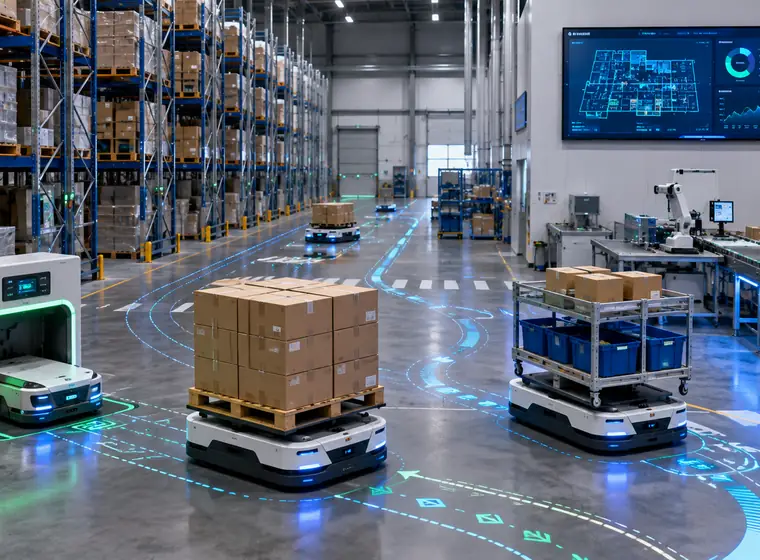
Autonomous guided vehicles and mobile robots for material movement and intralogistics – fleet integration that scales from a single route to a fully connected factory.
Manual material movement ties up labour, causes bottlenecks and risks safety incidents. We deliver autonomous mobile robot solutions and intralogistics automation across India and the UAE – AGVs along defined routes, AMRs navigating dynamically and re-routing around obstacles – as a material handling and warehouse automation system integrator.
We integrate the right mix for your facility and connect the fleet to your processes, so material arrives where it's needed, when it's needed, without adding headcount.
New in November 2026: what ISO 21423 means for multi-vendor AMR fleets.
AMRs that navigate dynamically, re-route around obstacles and adapt to changing layouts without floor infrastructure.
AGVs for high-volume, repeatable routes where a fixed, predictable path is the most efficient solution.
Towing and pallet-handling vehicles for line-side delivery and heavy intralogistics.
Central traffic control, charging management and task allocation across a mixed fleet.
Just-in-time delivery of parts and kits to production lines, synchronised with your processes.
Integration with lifts, doors, conveyors, production lines and your WMS or ERP for end-to-end flow.
We map your material flows, volumes and routes to size the right fleet and vehicle types.
Traffic, throughput and charging are simulated to validate the design before deployment.
Vehicles, fleet software and facility integration (doors, lifts, lines, WMS) are commissioned in phases.
Start with one route, prove it, then scale the fleet as confidence and volumes grow.
AGVs follow fixed, predefined paths (often using floor markers or magnetic tape) and suit high-volume repeatable routes. AMRs navigate dynamically using onboard sensors and maps, re-routing around obstacles – ideal for flexible or changing layouts.
AMRs typically need little or no fixed infrastructure. AGVs may need guide paths. We assess your facility during the flow study and recommend the lowest-disruption option.
Yes – that's the recommended approach. We prove one route or task, then expand the fleet as volumes and confidence grow.
Yes. We integrate with automatic doors, lifts, conveyors and production lines, and connect the fleet to your WMS or ERP for coordinated material flow.
Cost depends on the number of vehicles, payload, navigation type and fleet software needed – a single AMR handling one route costs far less than a multi-vehicle fleet integrated with WMS/ERP and automatic doors or lifts. We size the fleet to your material flow during an automation audit so the cost is shown against the labour and throughput it replaces.
For repetitive, predictable material movement, yes – they run consistent routes without operator fatigue, reduce handling damage and free forklift operators for exception work. They are not a wholesale forklift replacement; most plants run AGV/AMR fleets alongside forklifts for loads or routes that still need a human driver.
A single-vehicle pilot on one route can be running in weeks once the site survey and map are done; a multi-vehicle fleet integrated with WMS/ERP, doors and lifts takes longer. We phase deployment – prove one route, then scale the fleet – rather than committing to the full layout on day one.
Yes. We design, supply and integrate AGV and AMR fleets for manufacturers and warehouses across India and the UAE, including fleet software, WMS/ERP integration and automatic doors or lifts where needed.
Yes, with the right navigation choice. AMRs using SLAM navigation handle dynamic, tight-aisle environments well, while AGVs on fixed paths suit predictable, high-traffic routes; lift and door interlocks extend either to multi-storey facilities. We confirm what fits your layout during the site survey.
Tell us your line, your targets and your timeline. We'll come back with a phased, ROI-aligned roadmap – no obligation, no enterprise sales cycle.