
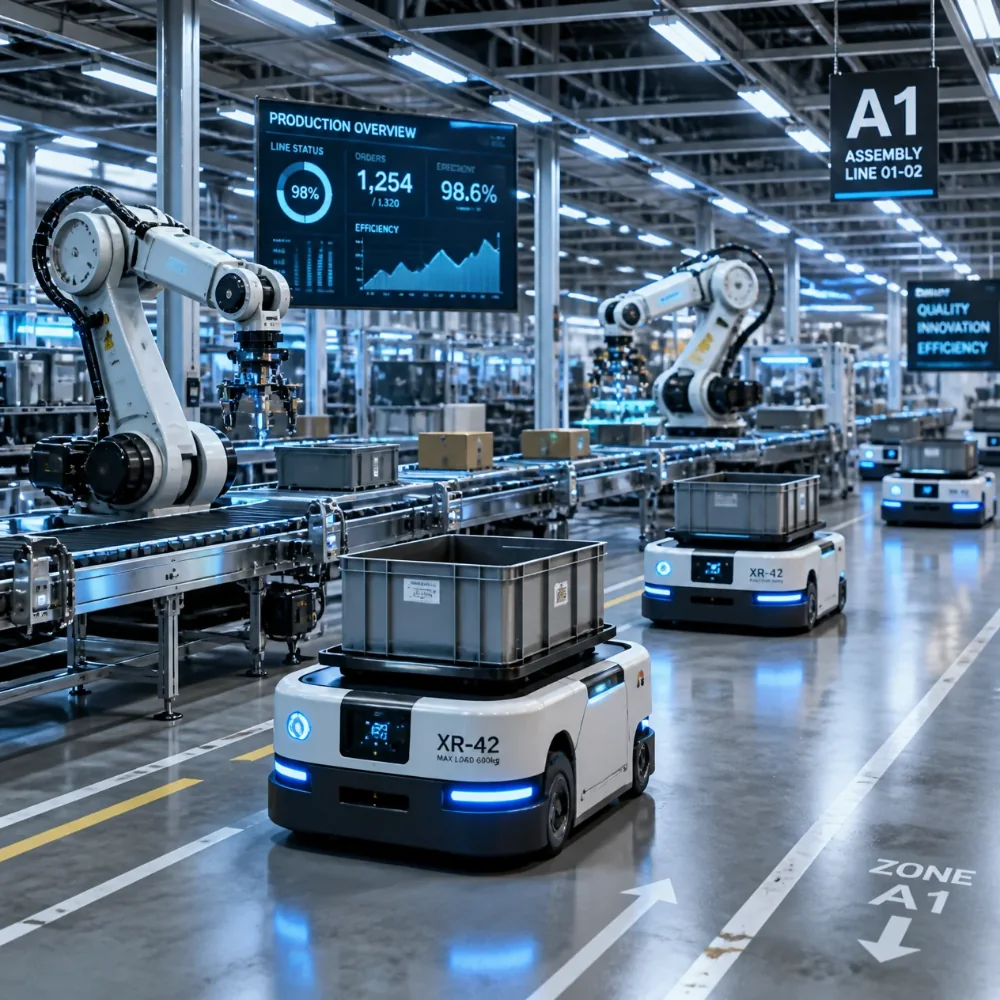
A new international standard gives industrial mobile robots a common language. For manufacturers early in their AMR journey – which is most of India and the Gulf – it arrives at exactly the right moment.
There is a conversation that happens about eighteen months into most mobile robot deployments, and it goes badly.
The first fleet went in and worked. Three or four AMRs moving material between stores and the line, a fleet manager from the robot vendor coordinating them, measurable savings on manual movement. So the plant approves a second phase – more robots, a different area, maybe a different application where another vendor's machine is genuinely the better fit.
And that is where it stops. The second vendor's robots cannot see the first vendor's robots. Two fleet managers are now each certain they own the aisle. The integration quote to make them coexist costs more than the robots. The plant either pays it, or quietly accepts that it is a single-vendor site for the next decade, whatever the pricing looks like at renewal.
On 2 November 2026, that problem got a standard.
The Association for Advancing Automation (A3) published ISO 21423:2026 – formally, Robotics: Industrial mobile robots. Communications and interoperability – developed through ISO Technical Committee 299.
It specifies how industrial mobile robots, their fleet managers and other equipment exchange information and request actions from each other, regardless of vendor or model. In practice, robots can share their location, speed, direction, condition, tasking and availability in a form another vendor's system can read.
According to A3, the end-user benefit is fewer cases of robots interfering with each other's paths or path planning, which improves robot availability and system efficiency. Carole Franklin, A3's director of standards development for robotics, noted that leading industrial users of mobile robots had been asking for an interoperability standard for years.
Two details matter more than the headline.
The first is scope creep in the useful direction. The standard does not stop at robot-to-robot. It covers communication with fleet managers and other industrial equipment – the lifts, doors and alarms a robot has to negotiate, and the systems that tell it what to do next. People carrying mobile devices can share similar information, so their movement can be coordinated alongside the robots rather than treated as an obstacle.
The second is that A3 describes this as the first non-safety robot standard it has helped produce. Robotics standardisation has historically been almost entirely about keeping people from being hurt. This one is about keeping assets from being stranded – which tells you something about where the industry thinks its problems now are.
ISO 21423 did not appear from nowhere, and its lineage is the reason to take it seriously.
It builds directly on the MassRobotics Interoperability Standard. MassRobotics formed an AMR Interoperability Working Group in 2020, bringing robot developers and end users together on a problem they were all hitting on the floor. Contributors included Vecna Robotics, 6 River Systems, Waypoint Robotics, Locus Robotics, Seegrid, MiR, Autoguide Mobile Robots, Third Wave Automation, A3 and Open Robotics. They focused on robot-to-robot information sharing – location, speed, direction, health and availability – and published it in 2021 as the first open-source AMR interoperability standard, freely available on GitHub.
The ISO standard also draws on VDA 5050, the German automotive industry's AGV communication interface, and uses MQTT and JSON as its transport and data format.
That last point is worth pausing on if you are already running an Industry 4.0 programme. MQTT is not an exotic robotics protocol – it is the same lightweight publish-subscribe messaging your edge gateways are most likely already using to move machine data to a historian or a dashboard. A robot fleet that speaks MQTT and JSON is a robot fleet your existing data layer can listen to without a translation tier. The interoperability story is not only robot-to-robot. It is robot-to-factory.
The International Federation of Robotics' World Robotics 2026 report, released in September, put India at almost 10,500 industrial robots installed during 2025 – up 15%, sixth in the world, with annual installations growing at an average of 27% a year between 2020 and 2025. Globally, the operational stock crossed five million units for the first time.
Read against this standard, those numbers cut a particular way.
Markets that automated earliest have the largest installed base of robots that predate any interoperability requirement. A plant in Germany or Japan with a decade-old mixed fleet carries real cost in retrofitting or replacing to reach a common communication layer.
India and the UAE are mostly not in that position. Most Indian manufacturers evaluating AMRs today are evaluating their first or second fleet. Most UAE facilities deploying intralogistics automation under Operation 300bn and Make it in the Emirates are building new rather than retrofitting. Arriving late to a technology is usually a disadvantage. Here it means you can write interoperability into your very first purchase order, and never accumulate the problem at all.
That window is open now and will not stay open. Every fleet deployed in the next two years without an interoperability requirement in the specification becomes the legacy estate somebody has to deal with later.
A standard existing is not the same as a standard being implemented. These are the questions worth putting in front of a vendor now.
Three things worth being clear about, because the coverage so far has been mostly celebratory.
It is not a safety standard. A3 is explicit that this is its first non-safety robot standard. ISO 3691-4 and the rest of the safety framework still apply in full, and nothing here reduces the risk assessment your integrator owes you.
It is not plug and play. A common communication standard means two fleets can exchange structured information about where they are and what they are doing. It does not mean two vendors' robots will cooperatively optimise a shared route on day one. Traffic management across a mixed fleet is still an engineering problem; the standard makes it a solvable one rather than a commercial dead end.
And it is not yet on anyone's spec sheet. The standard is available from the A3 online store for $373, or $320 for members. The clearest sign it has moved from a document to the plant floor will be ISO 21423 conformance printed on robot and fleet manager datasheets, next to payload and battery life. That has not happened yet. Until it does, treat vendor claims as roadmap statements rather than delivered capability – and get the date in writing.
If you are deploying mobile robots in the next twelve months, the practical move is not to wait for conformance. It is to write interoperability into the specification now, so that when conformance arrives you are positioned to use it rather than negotiating for it.
That means specifying what data the fleet manager must expose and to whom, confirming the vendor's existing alignment to MassRobotics or VDA 5050, and designing the data layer so robot telemetry lands in the same place as the rest of your machine data rather than in a vendor portal you cannot query.
We have argued for brand-agnostic design on every AGV and AMR project we have scoped, for the straightforward reason that a plant's requirements change faster than a vendor relationship should. ISO 21423 turns that argument from a design preference into something you can point at in a specification document.
Automation that cannot talk to the rest of the factory is not a connected factory. It is an expensive island with good uptime.
We scope mobile robot projects brand-agnostically – fleet design, traffic management, integration into your existing data layer, and a specification that does not corner you into one vendor's roadmap.