
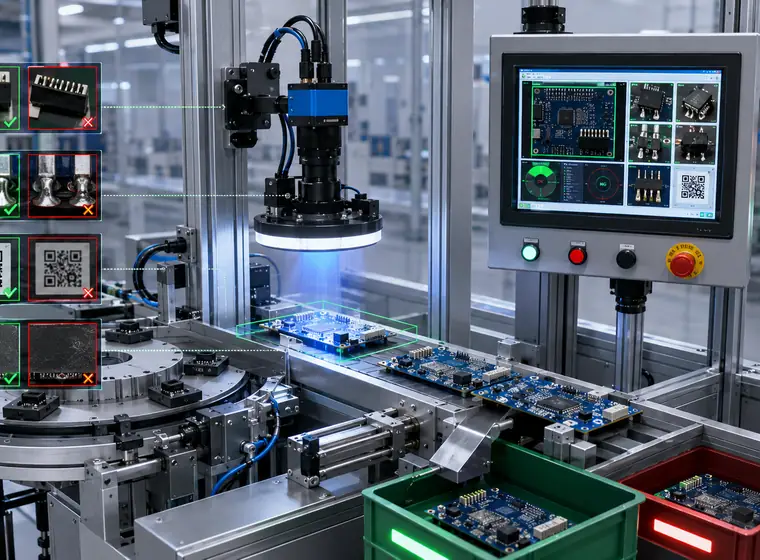
Machine vision and AI-based inspection for defect detection, measurement, OCR and vision-guided robotics – quality control that never blinks, at full line speed.
Manual inspection is slow, subjective and impossible to scale. As a machine vision system integrator, we build AI-based visual inspection systems for manufacturing that check every part at line speed, flag defects the human eye misses, and log a traceable record of every inspection.
We design and integrate 2D and 3D vision systems – from a single inspection station to vision-guided robotics – tuned to your parts, your defects and your acceptance criteria.
Surface, cosmetic and assembly defect detection using rule-based and AI models trained on your parts.
Non-contact gauging and measurement to verify tolerances at speed, with full data logging.
As an automated optical inspection (AOI) system integrator, we deliver AOI for electronics and assemblies – presence, placement, polarity and solder verification.
Read and verify printed text, date codes, barcodes and data-matrix marks for traceability.
Give robots sight for bin-picking, alignment and handling of parts that aren't precisely fixtured.
Deep-learning models that distinguish real defects from harmless variation, cutting false rejects.
We test your real parts and defects to confirm what vision can reliably detect, and to what accuracy.
Cameras, lenses, lighting and software selected and configured for your parts and environment.
We integrate with your line and robots, then train models and tune thresholds on production data.
Capability validation against your criteria, plus operator training and documentation.
2D vision inspects flat features like print, presence and surface defects; 3D vision adds height and shape measurement for warpage, volume and complex geometry. We pick based on your defect types.
Yes. For defects that are hard to define with fixed rules, we use deep-learning models trained on your images to separate true defects from acceptable variation and reduce false rejects.
Vision systems are designed around your throughput. We confirm achievable speed and accuracy during the feasibility stage before committing.
Yes – results, images and measurements can be logged and fed to your MES, ERP or quality databases for full traceability.
Yes. We design, supply and integrate machine vision inspection systems for production lines in the UAE – from a single inspection station to vision-guided robotics. Cameras, lenses, lighting and software are selected for your parts and defects rather than tied to one brand, and we test your real parts during a feasibility stage before you commit.
Cost depends on the number of inspection points, part complexity and whether AI-based defect detection is needed – a single camera station costs far less than a multi-station line with 3D measurement and AI models. We confirm scope and cost against your defect types during a feasibility stage using your real parts, before you commit.
A camera captures an image of each part under controlled lighting, and software compares it against a trained reference to check for defects, missing features, dimensions or print/label accuracy – in milliseconds, at line speed. Results, pass/fail decisions and images can be logged automatically for traceability.
For repetitive, high-volume checks, yes – vision systems don't tire, miss parts at shift changes or vary their judgement from person to person, and they log every result automatically. Manual inspection stays useful for ambiguous or low-volume judgement calls; most lines use vision for the repetitive checks and people for the exceptions.
Yes. TechTune Systems designs, supplies and integrates machine vision and inspection systems for manufacturers across India and the UAE – from a single inspection station to AI-based defect detection and vision-guided robotics – brand-agnostic and tested on your real parts before commitment.
Tell us your line, your targets and your timeline. We'll come back with a phased, ROI-aligned roadmap – no obligation, no enterprise sales cycle.