
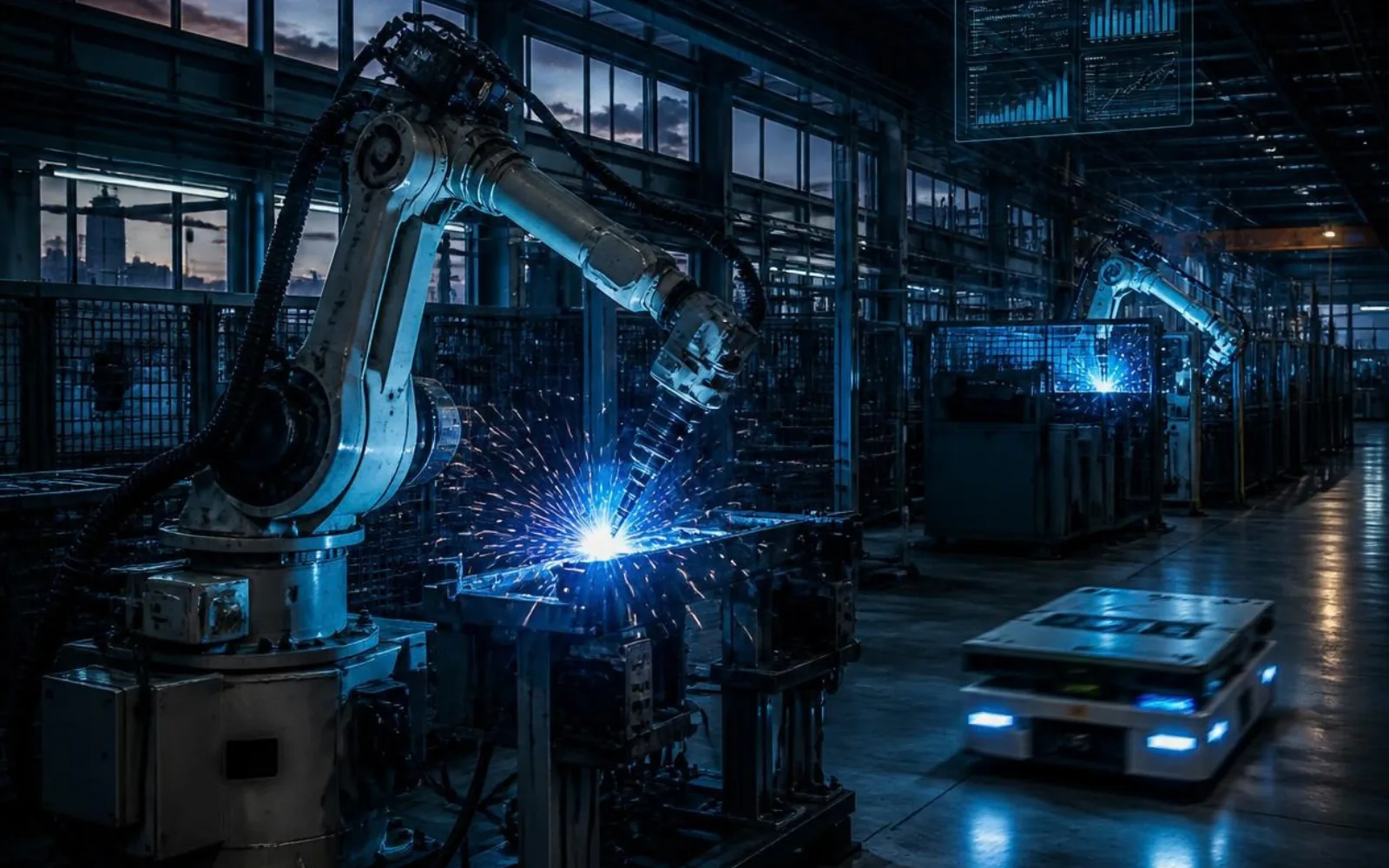
Lights-out manufacturing is one of the most searched terms in industrial automation right now. Here is what it actually means, what the 2026 numbers say, and how a manufacturer in India or the UAE should stage the move.
"Dark factory" gets thrown around to mean everything from one automated cell to a fully unmanned plant. Gartner projects that by 2026, 60% of manufacturers will have adopted some form of lights-out manufacturing – but almost none of that is a building with the lights off. It is a small number of proven use cases running unattended inside a plant that is otherwise very much staffed. Here is the practical version of what "going dark" means, and how to plan for it.
Read those numbers carefully and a pattern shows up: the growth is real, but it is concentrated in specific processes and specific shifts, not entire facilities. Philips' Drachten factory runs 128 robots on assembly with just 9 people on quality assurance – but those 9 people, and the engineering team behind predictive maintenance that flags failures up to 72 hours in advance, are very much part of the plant. That is what "dark" means in practice: unattended stretches inside a supervised system, not an empty building.
Three pressures are converging at the same time. Skilled operators – welders, machinists, quality inspectors – are getting harder to hire in every market TechTune serves. Manufacturers that automated one cell at a time are hitting the ceiling of what "automation islands" can do, because the line still loses output through manual handoffs between them. And government programmes are pushing hard on the same outcome: Make in India and the PLI scheme are pulling contract manufacturing capacity in, while Operation 300bn and Make it in the Emirates are doing the same for the UAE. Search interest in "dark factory" and "lights-out manufacturing" is rising because manufacturers are being asked, this year, what their plan actually is.
A plant does not "go dark" by buying robots. It goes dark by connecting five layers so a process can run without a person watching every step. This maps directly onto how we scope automation audits at TechTune:
| Layer | What it does | Where it fails without integration |
|---|---|---|
| Make & transform | CNC, SPM and machining that runs to a program | Stops the moment tooling wears or a part is out of spec, with no one to notice |
| Move & handle | Robots, cobots and AGV/AMR moving parts between stations | Jams and blocked material flow stall the whole line, not just one station |
| See & decide | Machine vision for defect and dimension checks | Bad parts keep moving downstream if inspection isn't inline and automatic |
| Connect & orchestrate | PLC/SCADA, MES and ERP tying the floor to the business | No visibility, no alarms, no data to act on when something drifts |
| Sustain & scale | Predictive maintenance, spares and a support plan | The first unplanned failure ends the "lights-out" run for good |
No manufacturer should target a fully unmanned plant on day one, and the market data does not suggest anyone credible is trying to. The staged path that actually works looks like this:
"Dark factory" is a useful shorthand, not a buying spec. The manufacturers seeing real payback in 2026 are the ones treating it as five layers to connect – machining, handling, vision, orchestration and maintenance – around processes with proven ROI, staged one line at a time. That is exactly how we scope every automation audit at TechTune Systems: brand-agnostic, ROI-aligned, and built to take the integration risk off the customer – across robotics, CNC, machine vision, AGV/AMR and Industry 4.0, for manufacturers in India and the UAE.
Start with an automation audit. We'll map which of the five layers is holding your line back and return a phased, brand-agnostic roadmap – no obligation.